Event Notification API Specification - v3.0
- Chris Michael (Unlicensed)
- Freddi Gyara (Unlicensed)
Version Control
| Version | Date | Author | Comments |
|---|---|---|---|
| 3.0-draft7 | OB R/W API Team | This is the initial draft version for draft7 | |
| 3.0-RC2 | OB R/W API Team | RC2 Changes:
| |
| 3.0-RC3 | OB R/W API Team | Errata:
RC3 Changes:
| |
| 3.0 | OB R/W API Team | Swagger URLs updated to point to latest stable version. |
Overview
The Event Notification API Specification describes the flows and payloads to allow ASPSPs to deliver event notifications to TPPs.
The ASPSP API endpoints described here allow a TPP to:
- Register a callback URL with an ASPSP to receive event notifications.
- Optionally read, update or delete a registered callback URL.
The TPP API endpoint described here allow an ASPSP to:
- Notify a TPP that an event has occurred.
This specification should be read in conjunction with the Payments, Accounts, and Confirmation of Funds API specifications. These specifications detail the circumstances under which an event notification may be delivered.
Implementation of the Event Notification API Specification is optional for both ASPSPs and TPPs.
Design Principles
Security Event Token Alignment
Event notifications are aligned with the Security Event Token standard - a proposed IETF standard for exchanging information about security events. See https://tools.ietf.org/html/rfc8417. An event notification is structured as a JWT, indicating an event has occurred through a set of claims.
A resource-update event (rurn:uk:org:openbanking:events:resource-update) is used to communicate that a specific resource has been updated. It contains identifiers for the resource and links to retrieve it.
Event Notification Message Signing
Event Notifications are singed for non-repudiation using the approach defined in the R/W API specification, with the following difference:
- The JWT's signature (JWS) is sent in the HTTP body of the request, as opposed to a detached JWS sent in the HTTP header.
Basics
Overview
The steps and sequence diagram below provide a general outline of a notification flow for all resources in the R/W APIs.
Steps
Step 1: Setup Event Notification Configuration
- This flow begins with a TPP creating a callback-url resource with an ASPSP.
- The callback URL must be specified at this stage.
Step 2: Event Notification Required
- When an event occurs on a resource that requires a notification, the ASPSP identifies the callback-url associated with the TPP owning the affected resource.
- The ASPSP sends the event notification to the callback URL, detailing the nature of the event and identifying the affected resource.
- The TPP initiates a client credential grant and retrieves the resource using the details contained in the event notification.
Step 3: Retrieve/Update/Delete Event Notification Configuration
- The TPP may optionally read/update/delete the callback-url resource.
Sequence Diagram
.png?version=1&modificationDate=1536313310906&cacheVersion=1&api=v2&width=800&height=1273)
Callback URL
TPPs must register a callback URL for TPP hosted services to receive event notifications from an ASPSP. The callback URL must end with the Event Notification API specification version number, followed by ‘/event-notifications'.
For example:
Release Management
This section overviews the release management and versioning strategy for the Event Notification API.
Callback-URL Resource
TPPs must register for event-notification callbacks with the version of Event Notification API they have implemented. The version element of the Callback-URL resource is used for this purpose.
POST
- A TPP must only create a callback-url on one version
GET
- A TPP must not access a callback-url on an older version, via the CallbackUrlId for a callback-url created in a newer version
- E.g., A callback-url created in v4, accessed via v3
- An ASPSP must allow a callback-url resource to be accessed in a newer version
- An ASPSP must ensure callback-url fields are unchanged when accessed in a different version
PUT
- A TPP must not update a callback-url on an older version via a CallbackUrlId created in a newer version
- E.g., A callback-url is created in v4, and request PUT on v3
- An ASPSP must support updating a callback-url from a previous version via a CallbackUrlId created in a newer version
- E.g., A callback-url is created in v3, and request PUT on v4
DELETE
- A TPP must not delete a callback-url on an older version via a CallbackUrlId created in a newer version
- E.g. A callback-url is created in v4, and request DELETE on v3
- An ASPSP must support deleting a callback-url from a previous version via a CallbackUrlId created in a newer version
- E.g., A callback-url is created in v3, and request DELETE on v4
Callback-URL per TPP
An ASPSP will maintain at most, a single Callback-URL resource per TPP.
Transport Level Security - TPP Endpoints
TPP hosted endpoints must be protected using TLS 1.2, as per the FAPI R/W specification (details here http://openid.net/specs/openid-financial-api-part-2-ID1.html#tls-considerations).
TPP hosted endpoints must be protected using an OB issued network certificate.
MA-TLS is not applicable to TPP hosted endpoints.
ASPSP Endpoints
A TPP will set up and maintain its call back details (URL and version number) using the callback-url resource.
Endpoints
| Resource | HTTP Operation | Endpoint | Mandatory ? | Scope | Grant Type | Message Signing | Idempotency Key | Request Object | Response Object |
|---|---|---|---|---|---|---|---|---|---|
| callback-url | POST | POST /callback-urls | Optional | accounts payments fundsconfirmations | Client Credentials | Signed Request Signed Response | No | OBCallbackUrl1 | OBCallbackUrlResponse1 |
| callback-url | GET | GET /callback-urls | Mandatory (if resource POST implemented) | accounts payments fundsconfirmations | Client Credentials | Signed Response | No | n/a | OBCallbackUrlsResponse1 |
| callback-url | PUT | PUT /callback-urls/{CallbackUrlId} | Mandatory (if resource POST implemented) | accounts payments fundsconfirmations | Client Credentials | Signed Request Signed Response | No | OBCallbackUrlResponse1 | OBCallbackUrlResponse1 |
| callback-url | DELETE | DELETE /callback-urls/{CallbackUrlId} | Mandatory (if resource POST implemented) | accounts payments fundsconfirmations | Client Credentials | n/a | No | n/a | n/a |
POST /callback-urls
POST /callback-urls
The API endpoint allows the TPP to ask an ASPSP to create a new callback-url resource.
- The POST action allows the TPP to register a callback URL for an ASPSP to send event notifications to.
- The ASPSP creates the callback-url resource and responds with a unique CallbackUrlId to refer to the resource.
- An ASPSP must respond with a 409 error if a callback-url exists for that TPP.
GET /callback-urls
GET /callback-urls
The API endpoint allows the TPP to ask an ASPSP to retrieve its callback-url resource.
- The ASPSP retrieves the callback-url resource and responds with the resource.
PUT /callback-urls/{CallbackUrlId}
PUT /callback-urls/{CallbackUrlId}
The API endpoint allows the TPP to ask an ASPSP to update a callback-url resource.
- The PUT action allows the TPP to update a callback URL for an ASPSP to send event notifications to.
- The ASPSP updates the callback-url resource and responds with the updated resource.
DELETE /callback-urls/{CallbackUrlId}
DELETE /callback-urls/{CallbackUrlId}
The API endpoint allows the TPP to ask an ASPSP to delete a callback-url resource.
- The ASPSP deletes the callback-url resource.
ASPSP Data Model
Callback Url - Request
The OBCallbackurl1 object will be used for the call to:
- POST /callback-urls
UML Diagram
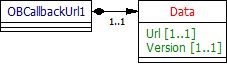
Data Dictionary
| Name | Occurrence | XPath | EnhancedDefinition | Class | Codes | Pattern |
|---|---|---|---|---|---|---|
| OBCallbackUrl1 | OBCallbackUrl1 | OBCallbackUrl1 | ||||
| Data | 1..1 | OBCallbackUrl1/Data | OBCallbackUrlData1 | |||
| Url | 1..1 | OBCallbackUrl1/Data/Url | Callback URL for a TPP hosted service. Will be used by ASPSPs, in conjunction with the resource name, to construct a URL to send event notifications to. | xs:anyURI | ||
| Version | 1..1 | OBCallbackUrl1/Data/Version | Version for the event notification. | Max10Text |
Callback Url - Response
The OBCallbackUrlResponse1 object will be used for a response to a call to:
- POST /callback-urls
- PUT /callback-urls/{CallbackUrlId}
The OBCallbackUrlResponse1 object will also be used for the call to:
- PUT /callback-urls
UML
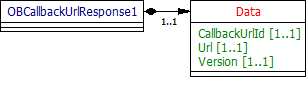
Data Dictionary
| Name | Occurrence | XPath | EnhancedDefinition | Class | Codes | Pattern |
|---|---|---|---|---|---|---|
| OBCallbackUrlResponse1 | OBCallbackUrlResponse1 | OBCallbackUrlResponse1 | ||||
| Data | 1..1 | OBCallbackUrlResponse1/Data | OBCallbackUrlResponseData1 | |||
| CallbackUrlId | 1..1 | OBCallbackUrlResponse1/Data/CallbackUrlId | Unique identification as assigned by the ASPSP to uniquely identify the callback URL resource. | Max40Text | ||
| Url | 1..1 | OBCallbackUrlResponse1/Data/Url | Callback URL for a TPP hosted service. Will be used by ASPSPs, in conjunction with the resource name, to construct a URL to send event notifications to. | xs:anyURI | ||
| Version | 1..1 | OBCallbackUrlResponse1/Data/Version | Version for the event notification. | Max10Text |
Callback Urls - Response
The OBCallbackUrlsResponse1 object will be used for a response to a call to:
- GET /callback-urls
UML
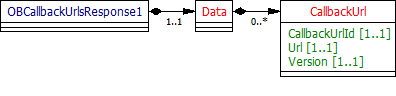
Data Dictionary
| Name | Occurrence | XPath | EnhancedDefinition | Class | Codes | Pattern |
|---|---|---|---|---|---|---|
| OBCallbackUrlsResponse1 | OBCallbackUrlsResponse1 | OBCallbackUrlsResponse1 | ||||
| Data | 1..1 | OBCallbackUrlsResponse1/Data | OBCallbackUrlsResponseData1 | |||
| CallbackUrl | 0..n | OBCallbackUrlsResponse1/Data/CallbackUrl | OBCallbackUrlResponseData1 | |||
| CallbackUrlId | 1..1 | OBCallbackUrlsResponse1/Data/CallbackUrl/CallbackUrlId | Unique identification as assigned by the ASPSP to uniquely identify the callback url resource. | Max40Text | ||
| Url | 1..1 | OBCallbackUrlsResponse1/Data/CallbackUrl/Url | Callback URL for a TPP hosted service. Will be used by ASPSPs, in conjunction with the resource name, to construct a URL to send event notifications to. | xs:anyURI | ||
| Version | 1..1 | OBCallbackUrlsResponse1/Data/CallbackUrl/Version | Version for the event notification. | Max10Text |
ASPSP Usage Examples
Create Callback Url
POST /callback-urls
POST /callback-urls HTTP/1.1
Authorization: Bearer 2YotnFZFEjr1zCsicMWpAA
x-jws-signature: TGlmZSdzIGEgam91cm5leSBub3QgYSBkZXN0aW5hdGlvbiA=..T2ggZ29vZCBldmVuaW5nIG1yIHR5bGVyIGdvaW5nIGRvd24gPw==
x-fapi-financial-id: OB/2017/001
x-fapi-interaction-id: 86ebcd82-8e38-4f2d-a79c-965b41d15865
Content-Type: application/json
Accept: application/json

{
  "Data": {
	"Url": "https://tpp.com/open-banking/v3.0/event-notifications",
	"Version": "3.0"
  }
}
POST /callback-urls response
HTTP/1.1 201 Created
x-jws-signature: V2hhdCB3ZSBnb3QgaGVyZQ0K..aXMgZmFpbHVyZSB0byBjb21tdW5pY2F0ZQ0K
x-fapi-interaction-id: 86ebcd82-8e38-4f2d-a79c-965b41d15865
Content-Type: application/json

{
  "Data": {
	"CallbackUrlId": "CB-101",
	"Url": "https://tpp.com/open-banking/v3.0/event-notifications",
	"Version": "3.0"
  }
}
Get Callback Urls
GET /callback-urls
GET /callback-urls HTTP/1.1
Authorization: Bearer 2YotnFZFEjr1zCsicMWpAA
x-fapi-financial-id: OB/2017/001
x-fapi-interaction-id: 86ebcd82-8e38-4f2d-a79c-965b41d15865
Accept: application/json
GET /callback-urls response
GET/1.1 200 OK
x-jws-signature: V2hhdCB3ZSBnb3QgaGVyZQ0K..aXMgZmFpbHVyZSB0byBjb21tdW5pY2F0ZQ0K
x-fapi-interaction-id: 86ebcd82-8e38-4f2d-a79c-965b41d15865
Content-Type: application/json

{
  "Data": {
	"CallbackUrl": [
	  {
	    "CallbackUrlId": "CB-101",
	    "Url": "https://tpp.com/open-banking/v3.0/event-notifications",
	    "Version": "3.0"
	  }
	]
  }
}
ASPSP Swagger Specification
The Swagger Specification for Event Notification ASPSP APIs can be downloaded from the following links:
TPP Endpoints
An ASPSP will send event notifications to a TPP using the event-notification resource.
Endpoints
| Resource | HTTP Operation | Endpoint | Mandatory ? | Scope | Grant Type | Message Signing | Idempotency Key | Request Object | Response Object |
|---|---|---|---|---|---|---|---|---|---|
| event-notification | POST | POST /event-notifications | Optional | n/a | n/a | Signed Request | No | OBEventNotification1 |
Notes:
- A TPP must make available a callback notification endpoint to receive event notifications.
- A TPP must acknowledge an event notification with a 202 HTTP response and include the provided
x-fapi-interaction-id.
POST /event-notifications
POST /event-notifications
The API endpoint allows the ASPSP to send an event-notification resource to a TPP.
TPP Data Model
Event Notification - Request
The OBEventNotification1 object will be used for a call to:
- POST /event-notifications
The OBEventNotification1 object is aligned with the Security Event Token (https://tools.ietf.org/html/rfc8417). It contains a single OBEventResourceUpdate1 event object within the events claim.
UML Diagram

The rid, rty and rlk claims are prefixed with the OB namespace http://openbanking.org.uk in the data model. The namespace has been removed from the diagram for clarity.
Notes
For the OBEventNotification1 object:
- The array of resource links (http://openbanking.org.uk/rlk) must contain links to all supported versions of the resource.
Data Dictionary
| Name | Occurrence | XPath | EnhancedDefinition | Class | Codes | Pattern |
|---|---|---|---|---|---|---|
| OBEventNotification1 | OBEventNotification1 | The resource-update event. | OBEventNotification1 | |||
| iss | 1..1 | OBEventNotification1/iss | Issuer. | xs:anyURI | ||
| iat | 1..1 | OBEventNotification1/iat | Issued At. | Max10NumericText | [0-9]{1,10} | |
| jti | 1..1 | OBEventNotification1/jti | JWT ID. | Max128Text | ||
| aud | 1..1 | OBEventNotification1/aud | Audience. | Max128Text | ||
| sub | 1..1 | OBEventNotification1/sub | Subject. | xs:anyURI | ||
| txn | 1..1 | OBEventNotification1/txn | Transaction Identifier. | Max128Text | ||
| toe | 1..1 | OBEventNotification1/toe | Time of Event. | Max10NumericText | [0-9]{1,10} | |
| events | 1..1 | OBEventNotification1/events | Events. | OBEvent1 | ||
| urn:uk:org:openbanking:events:resource-update | 1..1 | OBEventNotification1/events/urn:uk:org:openbanking:events:resource-update | Resource-Update Event. | OBEventResourceUpdate1 | ||
| subject | 1..1 | OBEventNotification1/events/urn:uk:org:openbanking:events:resource-update/subject | The resource-update event. | OBEventSubject1 | ||
| subject_type | 1..1 | OBEventNotification1/events/urn:uk:org:openbanking:events:resource-update/subject/subject_type | Subject type for the updated resource. | Max128Text | http://openbanking.org.uk/rid_http://openbanking.org.uk/rty | |
| http://openbanking.org.uk/rid | 1..1 | OBEventNotification1/events/urn:uk:org:openbanking:events:resource-update/subject/http://openbanking.org.uk/rid | Resource Id for the updated resource. | Max128Text | ||
| http://openbanking.org.uk/rty | 1..1 | OBEventNotification1/events/urn:uk:org:openbanking:events:resource-update/subject/http://openbanking.org.uk/rty | Resource Type for the updated resource. | Max128Text | ||
| http://openbanking.org.uk/rlk | 1..n | OBEventNotification1/events/urn:uk:org:openbanking:events:resource-update/subject/http://openbanking.org.uk/rlk | Resource links to other available versions of the resource. | OBEventLink1 | ||
| version | 1..1 | OBEventNotification1/events/urn:uk:org:openbanking:events:resource-update/subject/http://openbanking.org.uk/rlk/version | Resource version. | Max10Text | ||
| link | 1..1 | OBEventNotification1/events/urn:uk:org:openbanking:events:resource-update/subject/http://openbanking.org.uk/rlk/link | Resource link. | xs:anyURI |
Event Notification Retry Policy
ASPSP
An ASPSP's Event Notification Retry Policy defines behaviour when an event notification is unacknowledged or the ASPSP receives a 5xx error.
- An Event Notification Retry Policy must define an Exponential Backoff Policy to calculate the Retry Time Interval
- An Event Notification Retry Policy must define the Maximum Number of Retries an ASPSP will make before declaring the TPP Event Notification endpoint unresponsive and ceasing further attempts
- An Event Notification Retry Policy must define the Maximum Time Interval for Retries, after which an ASPSP will declare the TPP Event Notification endpoint unresponsive and cease further attempts
TPP
A TPP may make GET requests for its resources if its /event-notifications endpoint was unavailable for the Maximum Time Interval for Retries, as defined in an ASPSP's Event Notification Retry Policy.
TPP Usage Examples
Send Event Notification
POST /event-notifications
POST /event-notifications HTTP/1.1
x-fapi-financial-id: OB/2018/002
x-fapi-interaction-id: 14ba1762-a316-4a87-8d6e-5bfbefaf01d7
Content-Type: application/jwt

eyJhbGciOiJIUzI1NiIsInR5cCI6IkpXVCJ9.eyJpc3MiOiJodHRwczovL2V4YW1wbGViYW5rLmNvbS8iLCJpYXQiOiIxNTE2MjM5MDIyIiwianRpIjoiYjQ2MGEwN2MtNDk2Mi00M2QxLTg1ZWUtOWRjMTBmYmI4ZjZjIiwic3ViIjoiaHR0cHM6Ly9leGFtcGxlYmFuay5jb20vYXBpL29wZW4tYmFua2luZy92My4wL3Bpc3AvZG9tZXN0aWMtcGF5bWVudHMvcG10LTcyOTAtMDAzIiwiYXVkIjoiN3VteDVuVFIzMzgxMVF5UWZpIiwiZXZlbnRzIjp7InVybjp1azpvcmc6b3BlbmJhbmtpbmc6ZXZlbnRzOnJlc291cmNlLXVwZGF0ZSI6eyJzdWJqZWN0Ijp7InN1YmplY3RfdHlwZSI6Imh0dHA6Ly9vcGVuYmFua2luZy5vcmcudWsvcmlkX2h0dHA6Ly9vcGVuYmFua2luZy5vcmcudWsvcnR5IiwiaHR0cDovL29wZW5iYW5raW5nLm9yZy51ay9yaWQiOiJwbXQtNzI5MC0wMDMiLCJodHRwOi8vb3BlbmJhbmtpbmcub3JnLnVrL3J0eSI6ImRvbWVzdGljLXBheW1lbnQiLCJodHRwOi8vb3BlbmJhbmtpbmcub3JnLnVrL3JsayI6W3sidmVyc2lvbiI6InYzLjAiLCJsaW5rIjoiaHR0cHM6Ly9leGFtcGxlYmFuay5jb20vYXBpL29wZW4tYmFua2luZy92My4wL3Bpc3AvZG9tZXN0aWMtcGF5bWVudHMvcG10LTcyOTAtMDAzIn0seyJ2ZXJzaW9uIjoidjEuMSIsImxpbmsiOiJodHRwczovL2V4YW1wbGViYW5rLmNvbS9hcGkvb3Blbi1iYW5raW5nL3YxLjEvcGF5bWVudHMvcG10LTcyOTAtMDAzIn1dfX19LCJ0eG4iOiJkZmM1MTYyOC0zNDc5LTRiODEtYWQ2MC0yMTBiNDNkMDIzMDYiLCJ0b2UiOiIxNTE2MjM5MDIyIn0.-coUJsJVycbZufiWHi71TIQsCjP4gj9uZ4FOsNEysZ4
{
  "iss": "https://examplebank.com/",
  "iat": "1516239022",
  "jti": "b460a07c-4962-43d1-85ee-9dc10fbb8f6c",
  "sub": "https://examplebank.com/api/open-banking/v3.0/pisp/domestic-payments/pmt-7290-003",
  "aud": "7umx5nTR33811QyQfi",
  "events": {
    "urn:uk:org:openbanking:events:resource-update": {
      "subject": {
        "subject_type": "http://openbanking.org.uk/rid_http://openbanking.org.uk/rty",
        "http://openbanking.org.uk/rid": "pmt-7290-003",
        "http://openbanking.org.uk/rty": "domestic-payment",
        "http://openbanking.org.uk/rlk": [
          {
            "version": "v3.0",
            "link": "https://examplebank.com/api/open-banking/v3.0/pisp/domestic-payments/pmt-7290-003"
          },
          {
            "version": "v1.1",
            "link": "https://examplebank.com/api/open-banking/v1.1/payment-submissions/pmt-7290-003"
          }
        ]
      }
    }
  },
  "txn": "dfc51628-3479-4b81-ad60-210b43d02306",
  "toe": "1516239022"
}
POST /event-notifications response
HTTP/1.1 202 Accepted
x-fapi-interaction-id: 14ba1762-a316-4a87-8d6e-5bfbefaf01d7
© Open Banking Limited 2019 | https://www.openbanking.org.uk/open-licence | https://www.openbanking.org.uk